
Monday:
What is World History? The study of the history of the world.
What is BC and AD?
BC- before christ AD- anno Domini (Latin: In the year of our Lord)
How old is the earth? 4.6 billion years
Where the oldest human fossils were found? Africa- specifically Tanzania and Ethiopia
Who found the oldest human fossils? Louis and Mary Leakey, Donald Johanson, Recent scientists (Name??)
What are some of the biggest achievements in world history? tools and weapons, the wheel, fire, development of language, boats, arts
When were dinosours roaming this earth? 65-200 millon years ago
Louis and Mary Leaky
- Searched for Hominid remains in Tanzania from the 1930's-1970's
- Hominid- the group consisting of all modern and extinct Great Apes ( Modern Humans, Chimps, Gorillas, and orangutans plus all their ancestors)
- Found human like fossils in 1959 (TAKE MORE NOTES ON POWER POINT)
Donald Johanson
- Discovered 3.2 million year old fossil of a female skeleton in Ethiopia (Lucy)
Homo- Sapiens
Neanderthal vs Cro-magnon (Know this) vs Modern- The man got smarter
Agricultural/ Neolithic Revolution
- prior to more organized agriculture, people were nomadic and hunted animals and gathered plants- hunter-gatherer
- They lived in groups of about 25-70 people
- No one knows exactly how things changed, but about 10,000 years ago, people started more organizined farming
- Along with planting crops, people also Domesticated animals such as horses, dogs, goats, pigs
temp increased after ice age When its warmer it's easier for plants to grow and animals/humans to live
Ancient Sumerian City of UR
Building cities
- As time went on, people started setting up villages, which then over time, turned into towns and then some into cities
- As cities emerged, more complex ways of thinking and living emerged leading to civilization
- as cities grew, social classes emerged
Define civilization
- an advanced state of human society, in which a high level of culture, science, industry, and gov't been reached
5 traits of civilization
- Advances cities
- writing/record keeping
- specialized workers
- complex institutions
- advanced technology
What are natural borders? Rivers, oceans. Borders that separate countries that are not man made.
Why are defensible borders important for a civilization to thrive? It will keep out invaders, big water sources
What are some natural boundaries that would be helpful to an early civilization? Mountains, desert, big bodies of water.
- Arose in 4 separate river valleys around 3500 BC
- Fertile soil, mild climate, waterway for transportation, water for crops and drinking
- provided for abundant crops and food surpluses
Tuesday:
Ch. 1 Vocab
BC
AD
Hominid
Nomadic
Hunter-gatherer
Domesticated animals
Civilization
Social Classes
Ch. 2.1 Vocab
- Fertile Crescent- semicircle of fertile land stretching from SE coast of Mediterranean around Syrian Desert N of Arabia to Persian Gulf
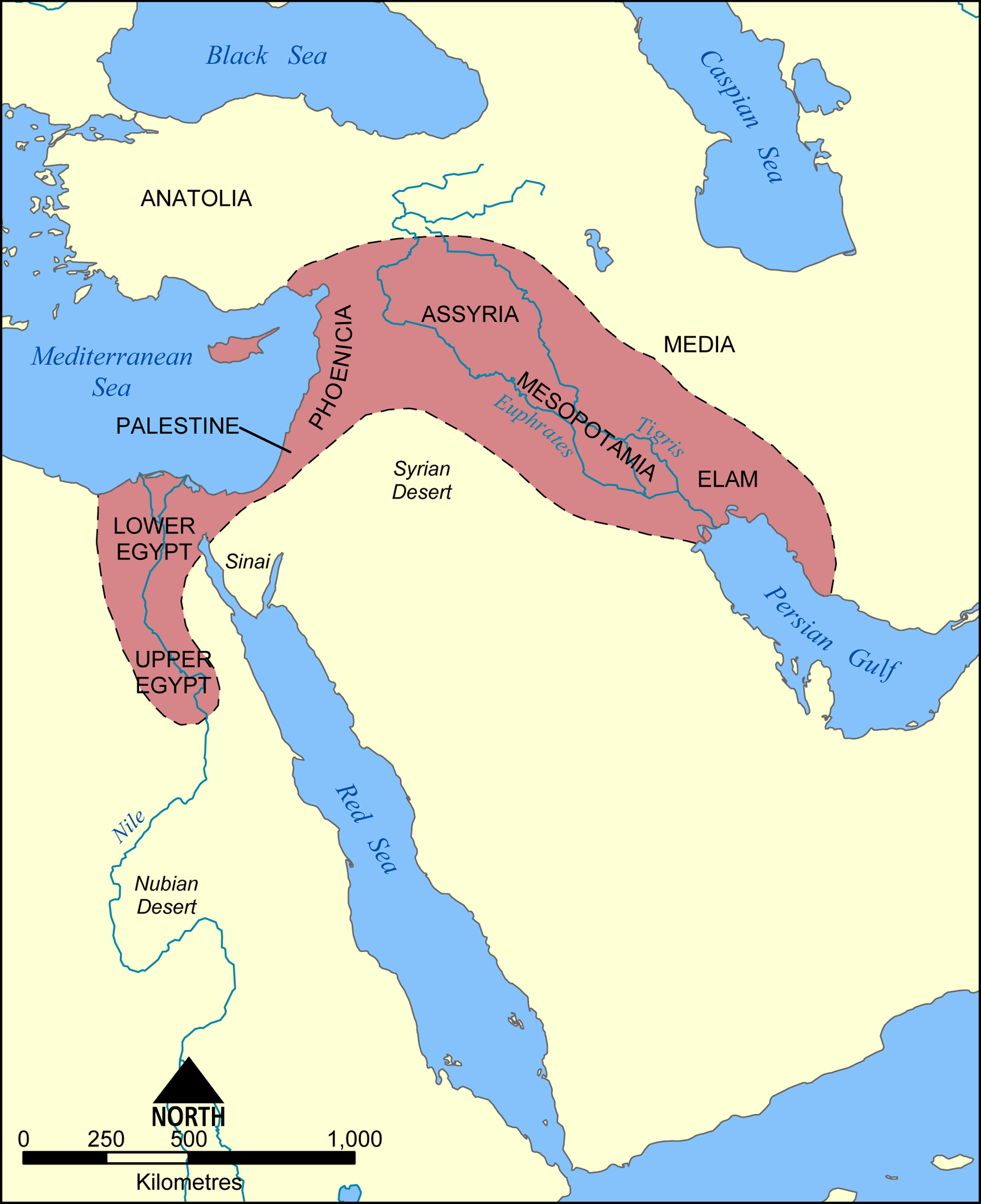
- Mesopotamia- ancient land that lies between the Tigris and Euphrates rivers, The land between 2 rivers. Basically Iraq
-
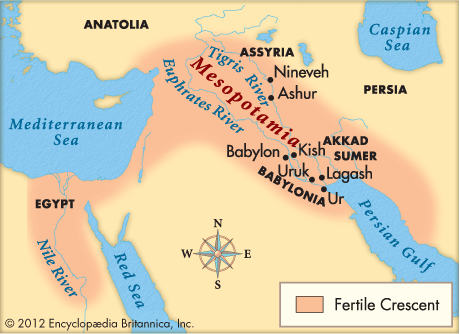
- City-state- A state that has its own gov't and consists of a city and the area around it. Functioned like an independent country.
- Dynasty- a series of rulers from the same family. Father to son usually.
- Cultural diffusion- process in which idea spread from one culture to another
- Polytheism- the belief in many gods
- Monotheism- belief in one god
- Empire- group of territories or nations ruled by a single ruler
Ch. 2.2 Vocab
- Delta- a broad, marshy area of land formed by deposits of silt where a river runs into a bigger body of water
- King Narmer- king of egypt that many believe united Upper and Lower egypt BC
- Pharaoh- The god- kings of Egypt seen as almost as powerful as the gods of the heavens
- Theocracy- Gov't headed by religious leaders or a leader regarded as a god
- Pyramid- Huge structure where the Egyptian pharaohs are placed after they die
- Mummification- the process of dying and embalming a corpse to prevent decay
- Usually reserved fir royalty and rick
- Hieroglyphics- eyptian form of writing
- Papyrus- What Egyptians wrote on. Came from Papyrus reeds found in marshy areas.
Wednesday:
Ch. 2.3 Vocab
- Indian Subcontinent- the land mass that includes Pakistan, India, Bangladesh
- Monsoon- Seasonal winds that can bring dy air or heavy rain- Huge impact on India
Ch. 2.4 Vocab
- Dynastic cycle- the rise, fall and replacement of dynasties
- Mandate from Heaven- A just ruler that has approval from the gods
- an unjust ruler can lose their mandate to rule
- Feudalism- A political system in which the king gives land to nobles/lords and in return, they vow loyalty and military service to the king
- Used in china, Japan, and Europe
- Feudal society
- king
- nobles and lords
- knights
- peasants/serfs
I AM SUMERIAN
- Code of Hammurabi (longest/oldest document of laws)
- agricultural based economy
- made money by farming
- irrigation
- awilu- upper class
- mushkenu- lower class
- parents could sell their children
- men could sell their whole family
- Wardu- slave
- most slaves were prisoners of war
- some Mush kenu were reduced due to certain offenses
- kings, nobles, free citizens, military, slaves
- believed in mythology
- education on being scribe
- marriage approved by parents
- women- property- business- witness
- men- farmers- authority
- hammurabi- offences ranging from matters such as witchcraft, military service, land and business regulation, family laws, wages, loans and debts.


Comments