
As the 34th President of the United States, Eisenhower walked into many challenges, facing, as his campaign slogan noted, "Communism, Korea, and Corruption". With this powerful message, he won the 1952 election against Adlai Stevensen in an absolute landslide.

Though he accomplished much during his time in office, he came from humlbe beginnings; born in Denison, Texas, the third of seven children. His father was an engineer by trade, but the family was reletively poor.
After graduating from Abilene High school, Eisenhower attended The United Statees Military Acadamy at West Point in 1911, and quickly rose to the top as an intelligent and driven young man, as well as a profeiciant athlete. He became an executive officer to General Fox Connor around the Panama Canal where he was stationed until 1924.
In 1939, he was appointed Cheif of Staff to General Walter Kruegar, as well at commander of the 3rd Army. Though he was promoted to brigadeer general , his lack of experiance leading men in the feild made him more apt to strategic planning.
After the attack on Pearl Harbor, he was assigned to designing the plans to defeat Japan and Germany. In 1942 he was appointed supreme commander allied force of the North african threatre of operations .Eisenhower later ovesaw the invasions of Sicily and the Italian mainland.
Roosevelt even chose him over Marshall as the as the Supreme Allied Commander in Europe. In these positions he was charged with carrying out the assault on Normandy.
As recognition for all of his accomplishments, Eisenhower was promoted to General of the Army, or Feild Marshall. He won much respect from frontline men and subordinates alike; as he dealt with disagreements in strategy with Churchill and Montgomery.
After the war he replaces Marshall as cheif of staff of the Army, as well as a short stint as the president of Columbia University.
In 1952, comrades and Republican party members started a movement for his presidency. During his campaign, he swore to go to Korea himself and end the war there, with Richard Nixon at his side.
During his presidency, one of his more noticeable achievements was the signing of the bill to authorize Interstate and highways systems in 1956; he justified it as a means of evacuation from large cities, due to the cold war. As far as his forgeign policy, it was littered with supposed assassinations, from leaders of Iran, Guatamala, and possibly the Belgian Congo. His administration also attempted to overthrow fidel castro in the Bay of Pigs invasion. However, his foreign policy was mostly dominated by the Cold War; after the death of Stalin, he attemped to extend peace to the soviet union, but tensions were still high. He did, however, open relations with spain, and built a trading relationship with the country, though it was widely noted that Spain's government was highly undemocratic. He made the Trade and Military agreement official with the Pact of Madrid, ending the isolation of Spain, brought on by WWII.
Eisenhower also accomplished Great Feats during the Korean War, and on July 27th, 1953, he signed the Korean Armistice Agreement, along with defense agreements in South Korea and China.
He expanded the role of the National Security Council and became known for making several televised appearances. Under his presidency, the U.S. evolved as a global nuclear power, which spurred the Cold War into Being, with fears of global annihilation and the race to obtain the most deadly weapons.
Eisenhower was truly great in the aspect of foreign affairs, but took a small role in the art of domestic affairs. He did not campaign to cut taxes; and three recessions occurred during his terms.
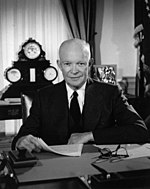
He did, however, take a stake in the domestic policy or immigration, and launched Operation Wetback in response to increasing immigration from Mexico to the United States. This is one of the issues that surprised me the most; knowing the terms used in this operation, and knowing that domestic issues and his stance on them, were not what got him elected into office, it was more so forgein affairs that he seemed to care a great deal about.
It is easy to look at the story of this man and be amazed; in my opinion, he was one of the greats. He solved so many problems and NEVER stopped going. Yes, he made mistakes, all presidents do, but he did what he knew was right for the country, not right for any specific party or political pundit. He fought Crohn's disease, a very painful chronic gastro-intestinal issue, he survived a mild stroke, and even a heart attack all before his second term. He was an amazing man, a hero, and a visionary.
Sources:
http://en.wikipedia.org/wiki/Presidency_of_Dwight_D._Eisenhower
http://en.wikipedia.org/wiki/Dwight_D._Eisenhower

Comments