
Key Terms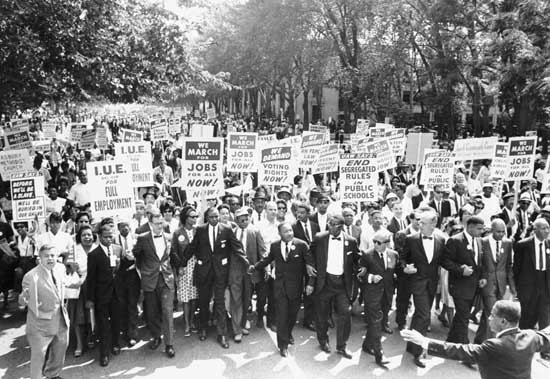
Civil Rights for African-Americans – African American wanted to end desegregation, which involved receiving the same rights as whites. Many things they couldn’t do, like vote or even attend the same schools as whites. Most of the activity took place in the South between 1954-1968. The Civil Rights Act of 1964 and Voting Rights Act of 1965 were established in response to the fight for equality by African Americans. Many organizations, such as NAACP, CORE, SNCC, and SCLC were created during the time period.
Civil Rights for Women – During the 1960s women believed in feminism, where they would have the same rights as men. 40% of women were working for wages in areas that weren’t considered “men’s work”, like clerical work, in the 1960s. The money they were making was still significantly less than men. Women felt discriminated against because men were brushing them aside and they were never promoted into high positions no matter how high their skill levels were. Civil Rights Act of 1964 helped the women’s movement gain strength. Betty Friedan created the National Organization for Women (NOW), which pushed for larger bans on gender discrimination in hiring and declaring it illegal to refuse women for jobs traditionally saved for men. Congressed passed a ban on gender discrimination in educational programs or activities receiving federal assistance financially in 1972. Roe v. Wade came to the conclusion that women had the right to have an abortion during the first three months of pregnancy.
Civil Rights for Latin-Americans – The 1960s showed a jump in the Latino population of the United States from 3 million to more than 9 million. Most of them migrated to the United States for better paying jobs. They experienced lots of discrimination: Their unemployment and poverty rates were 50% higher than whites. In the 1960s they began to demand equal rights and respect of their heritage. The United Farm Workers Organizing Committee was created to achieve higher pay and better treatment of the Latino farmers in the United States. The Bilingual Education Act was passed in 1968 to fund schools for language and heritage classes for non-English speaking students. Latinos also became more involved in politics during the 1960s.
Civil Rights for Native Americans – In 1968 the National Council on Indian Opportunity was created to ensure that programs include and help Native Americans. The process of equality was moving slowly, so many young Native Americans created the American Indian Movement. It started as a group against police brutality, but later launched into protecting rights. The rights they demanded included restoration for lands, burial grounds, and new respect for their culture. They confronted the government, sometimes even ending violently. To give them greater control over their children’s education, Congress passed the Indian Education Act in 1972 and the Indian Self-Determination and Education Assistance Act in 1975. Native Americans also received over 40 million acres of the native lands.
NAACP – Under Charles Hamilton Houston, the National Association for the Advancement of Colored People worked to end segregation in schools. Ten times as much money was being spent to educate white children than African American children. In 1938 Houston put Thurgood Marshall in charge of a group of his best law students. Over the years the group won 29 of 32 court cases. Some of those cases made it illegal to segregate seating on interstate buses and said state law schools must accept black students.
Martin Luther King Jr. – Marin Luther King Jr. was a pastor at Dexter Avenue Baptist Church and leader of the Montgomery Improvement Association. He believed in protesting without violence. He also started the Southern Christian Leadership Conference following the bus boycott to continue with non-violent protests. He was arrested for his non-violent protests. On August 28, 1963, he gave his famous “I Have a Dream” speech in front of the Lincoln Memorial in Washington DC. The speech asked for peace and harmony. He was in charge of many marches and peaceful protests. He was against Stokely Carmichael’s black power approach, saying that nothing good could come from preaching violence. On April 4, 1968, King was shot and killed on his hotel balcony in Memphis.
Malcolm X – Malcolm X was a Muslim minister and spokesman for the Nation of Islam. He became a minister after his release from jail and changed his last name to get rid of his ‘slave name’. His speeches and activism sparked a new wave in African American pride and the search for equal rights. He played a role in trying to ending other terms that described African Americans that weren’t “black” or “Afro-American”. He was known for his controversial statements. He even frightened many whites. On February 21, 1965, he was shot and killed while giving a speech in Harlem.
Jackie Robinson – He played in the Negro Baseball League for one year in 1945. In 1947 he was asked to join the Brooklyn Dodgers. He was the first African American major league baseball had had since 1889. He earned the title of National League Rookie of the Year after his rookie season. He was selected as the National League’s MVP in 1949. He was inducted into the Baseball Hall of Fame in 1962. He played an important role in desegregation, specifically in the area of sports.
Brown v. Board of Education of Topeka – On May 17, 1954, NAACP experienced their greatest victory. Linda Brown was an eight year old who was trying to go to an all-white girl’s school. Her father charged Topeka’s board of education for not allowing Linda to go to the school, which was only four blocks from their home, when the closest black school was 21 blocks away. The Supreme Court unanimously voted in favor of the Browns.
De-segregating the US Military – African Americans who served in the military were in a very racist environment. African Americans were threatening to not serve in the military if the conditions they were experiencing did not improve. Executive Order 9981 made discrimination against military personnel because of race and religion illegal. Racism still existed in the military, but African Americans were able to serve in the military just like the whites were.
Little Rock 9 – Arkansas was the first Southern state that would admit African Americans into universities without in 1948. Citizens even elected school board members who backed desegregation. Governor Faubus supported segregation, and in September 1957 ordered the Nation Guard to keep nine African-Americans from joining Little Rock’s Central High School. A judge ordered that the students should be allowed into the school. The students were able to go to school as soldiers followed them everywhere to protect them the best they could. By the end of the year the school shut down since it was having trouble with integration.

Rosa Parks and the Montgomery Bus Boycott – Jo Ann Robinson wrote a letter to the Montgomery mayor asking to stop making blacks give up their seats for whites, but he refused. A year later an event happened that would change everything. Rosa Parks was a seamstress and NAACP officer. On December 1, 1955, she sat down in the front row of a public bus’ colored section. When the bus was full and a white man needed the seat, the driver told Parks and three others to move so the man could sit without being by any African Americans. She refused, and just looked out the window. When the driver threatened to call the police on her, she still didn’t move and told him he could. The Montgomery Improvement Association was created to head the bus boycott following her arrest.
Greensboro Sit-Ins – African Americans from North Carolina’s Agricultural and Technical College participated in a sit-in at a lunch counter reserved only for whites in 1960. Television crews covered the whole thing, even whites beating and pouring food over the students. No matter what happened to them, the students refused to return the violence. The sit-in in Greensboro started other similar sit-ins across the United States. In late 1960 the work had paid off, and many lunch counters became desegregated in 11 different states.
Freedom Rides – In 1961 two buses were taken across the South in hopes to cause a violent protest to force the government to end segregation on public buses. White racists got on the first bus at the Alabama state line carrying chains and pistols. They beat the African Americans and anyone who tried to stop them. Bus Two continued on with the trip, and in Anniston, Alabama, a group of 200 whites were ready to attack the bus. They followed the bus, blew a tire, smashed a window, and threw a fire bomb. Luckily, all the passengers were out of the bus before the bus exploded. When the bus company refused to take the freedom riders and farther, word came that volunteers in Nashville would take them the rest of the way. Police pulled them over, beat them, but later let them go on with the trip. When they arrived in Montgomery whites were once again waiting and ready to beat them. President Kennedy sent 400 U.S. Marshalls to accompany and protect them on the rest of their trip to Jackson, Mississippi. Segregation was banned on all interstate transportation.
Birmingham, Alabama—1963 – Birmingham was very strict on segregation. On April 3, 1939, Martin Luther King Jr. flew to Birmingham to help end the racial violence. He was planning on holding a meeting with members of the African-American community. After days spent in Birmingham trying to stop the violence, King and others were arrested. On May 2 more than 1,000 African American children marched in the streets, and over 900 of them were arrested. The next day children tried to protest again, but police chased and hit them. After continued protests and negative media coverage, Birmingham began to desegregate.
Mississippi Summer Project (Freedom Summer Project) – Freedom Summer, which was focused in Mississippi, was a plan to register as many African Americans to vote as possible and receive national attention for it. The hope was that Congress would pass a voting rights act. College students were recruited and trained in nonviolent resistance. Out of the thousands of students that volunteered to help register voters, most were white and substantial amounts were women. Three of the workers disappeared and were later learned to be murdered my police. Beating and murders continued through the summer of 1964, as well as buildings, churches, and homes being burned. The Mississippi Freedom Democratic Party was formed.
Selma, Alabama—1965 – Many of the voting rights campaigns were held in Selma. Thousands of African Americans had been killed during the campaigns. After a member was killed, Martin Luther King Jr. announced he was going to lead a protest march from Selma to Montgomery. 600 protestors joined him on March 7, 1965. Police attacked and beat the protestors. On March 21, 1965, 3,000 protestors decided to do the same, only this time they had federal protection. By the end the number had grown to 25,000.
Voting Rights Act of 1965 – Congress passed Johnson’s act in the summer of 1965. It eliminated literacy tests before being able to vote. The tests had made many African Americans ineligible for voting. The percentage of African American voters in the South tripled.
Civil Rights Act of 1964 – President Johnson signed the Act on July 2, 1964. It prohibited discrimination because of race, religion, national origin, and gender. It also gave all citizens the right to enter libraries, parks, restaurants, theaters, and other public places. The act did not protect against police brutality, discrimination in private employment, and other such aspects. It was originally President Kennedy’s plan in 1963.
Stokely Carmichael – Police arrested and beat him for setting up a tent at an all-black high school in Greenwood, Mississippi. He believed in black power, which told African Americans they should begin to define their own goals. He also told the SNCC, of which he was a member, they should stop working with whites and focus on African American pride.
Black Panthers – The Black Panthers was a political party set up in October 1966 in Oakland, California. It focused on ending police brutality, full employment, and equal housing. They also believed blacks shouldn’t have to be drafted into the military because of the outrageous number of young African Americans being sent to Vietnam. They dressed in black leather jackets, black berets, and sunglasses. Many shootouts took place between the Black Panthers and police. They created many services, such as daycare centers, free breakfast programs, free medical clinics, and assistance to the homeless.
Affirmative Action – The government began to promote affirmative action in the 1960s to help with equality in education and employment. It made a special effort to hire and enroll those who have experienced discrimination. Almost all colleges and businesses that are connected to the federal government adopted the idea. Later, many said affirmative action was “reverse discrimination”.
Jesse Jackson – He was a Baptist minister and civil rights activist. He participated in the Selma to Montgomery march and joined the SCLC. He wanted to give African Americans a sense of self-worth. He founded and head Rainbow PUSH, which were involved in social justice, civil rights, and political activism. He was also a Democratic candidate for the 1984 and 1988 presidential elections.
 Source Source Source Source Source
"The American" History Book


Comments