
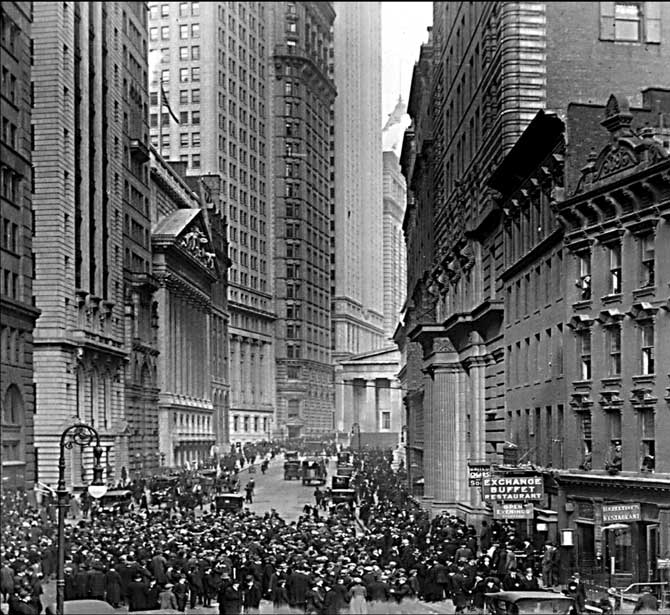
The stock market crash of 1929 was not expected at all. The stock market was actually doing very well leading up to the days known as Black Thursday and Black Tuesday. Americans started to become content with what they had, and that led to less spending on items like radios and cars. Overall, the crash seemed to have happened overnight. People who had invested money lost it all, and millionaires lost millions.
The crash happened on October 24th and 29th of 1929. On September 3rd of that year, the Dow Jones had reached its all-time high. But on October 24th, that number had dropped 21%. The sudden decline caused a panic. That day in 1929 is known as the starting point of the stock market crash, which lasted from 1929-1932. On Thursday the 24th, there were 13 million shares of stocks traded, but by the end of the day the prices had dropped so steeply that no one could keep up.
On October 25th, major banks like Morgan Bank, Chase National Bank, and National City Bank decided to purchase shares of U.S. Steel above market price. When the New York Stock Exchange failed in 1907, a similar strategy had worked to recover it. But in 1929 the effort was unsuccessful. On Tuesday the 29th, over 16 million stocks were traded and the stock market lost about $14 billion that day. By the time the crash was over in 1932, stocks had lost 90% of their values.
Although it might have looked and felt like the crash happened very suddenly, there were many factors leading up to it. The stock market had gained popularity and a reputation of being a safe and rewarding way to invest money. People believed the prices of the stocks were going to rise forever, but when businesses realized that the prices were almost too high to be real, they started trading, which lowered the prices of stock. Influential sources (like people and the media) were trying to stop speculators.
Another problem was the roaring twenties. People were living with enjoyment of wealth and excess and no worries, and also greed. There was many extreme investment trusts and margin buying. Factories and farmers were over-producing goods, banks lost their customer’s money in the crash and had nothing to pay them back with, and President Hoover wanted the families of America to turn it around, not the government.
I think the stock market was the fault of many reckless minds working together. It still happens today, which is almost embarrassing to know we really haven’t improved much. But history repeats itself, as they say. If big-wigs in business would have thought things through a little bit more, our government would have had tighter handles on the businesses and banks, and the people of the twenties weren’t so free-spirited, things probably would have turned out a lot better. I’m not saying the stock market crash would have never happened, because no one can say something like that for sure, but I do believe it wouldn’t have been so extreme and could have quite possibly prevented or shortened the depression that followed. The stock market crash of 1929 is living proof that no matter how content you are at one point, everything can come crashing down (literally) at any moment.
 Source Source Source
Hoover's Philosophy/Cautious Steps
President Hoover believed that the government would help find a solution for a conflict between groups and interests in society. He believed that the government was there to encourage voluntary cooperation and not control it. He also believed that people should not depend on the government for their own needs but take care of themselves. To President Hoover, handouts from the government would weaken people’s self-respect and morals. He wanted other people, charities and organizations, not the government, to help the people that needed it. He wanted to government to promote individual freedom and how the individuals will promote and protect businesses.
President Hoover asked leaders in the business, banking, and labor fields to work together to create solutions for the economy after the stock market crash. He wanted them to come up with ways that would not make the situation any worse. He asked many companies to cut wages or lay off employees. Although he tried many things similar to that, noting helped. The economy kept getting smaller and unemployment kept rising.
I couldn’t really find anything besides from the book for this topic. Mr. Bruns, I think you know I’m serious when I say I looked for almost an hour and it’s driving me nuts I couldn’t find more on this topic! I don’t really agree with Hoover’s views. Yes, I understand and agree the government shouldn’t be handing things out right and left to people, but there ARE people out there who need help and for whatever reason the people that can afford to help them won’t. I’m there, I know what it’s like. I also wonder why Hoover and the professionals he went to after the stock market crashed didn’t come up with more ideas that could have worked. You would think someone would have an idea to at least help the country out.
 Source Source


Comments
Excellent job as always!
In regards to not being able to find much on Hoover's philosophy, what did you search for? This is what I put in Google and found some info pretty quickly:
"hoover philosophy and the great depression"