
National Recovery Administration(NRA)/National Industrial Recovery Act(NIRA):
Year Passed:
(Also know as the act of) June 16, 1933, passed by President Franklin Delano Roosevelt.
Basic Definiton:
authorized the President to regulate industry and permit cartels and monopolies in an attempt to stimulate economic recovery, and established a national public works program. Title I: devoted to industrial recovery, and authorized the promulgation of industrial codes of fair competition, guaranteed trade union rights, permitted the regulation of working standards, and regulated the price of certain refined petroleum products and their transportation. Title II established the Public Works Administration, outlined the projects and funding opportunities it could engage in, and funded the Act.
What it specifically did(give examples):
Legislative power given to the executive branch. Section 7 required that each code specify maximum hours, minimum wages, safe working conditions, and workers' right to organize. Larger organizations were thought to be fitting the codes to the company instead of the other way around. Business was growing hostile to the provisions protecting labor and to the codes' administrative complexity. The codes distorted the economy by artificially raising wages and prices, restricting output, and reducing productive capacity by placing quotas on industry investment in new plants and equipment. One of the economic effects of monopoly and cartels is higher prices. Higher prices were an intentional outcome of the Act because defaltion was a severe problem at the time.
Was it successful overall(explain)"
No. Among the suggested causes for failure are that the Act promoted economically harmful monopolies, that the Act lacked critical support from the business community, and that the Act was poorly administered. Endorsed monopolies. Lacked support from the business community.
Is it still around today:
No, it was declared unconstitutional May 27, 1935 in Schechter Poultry Corp v. United States.
National Recovery Administration(NRA):
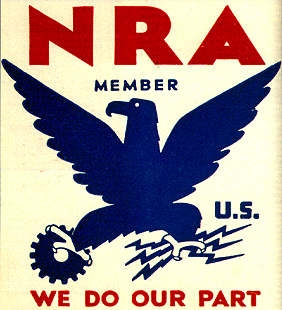
Established by Executive Order to develop and administer an industrial code system that would exert controls over industrial pricing, production, trade practices, and labor relations, thereby promoting economic recovery. Declared by the Supreme Court that it infringed the separation of powers. It's symbol was a blue eagle.
The 3 R's:
Relief. Recovery. Reform.
The Relief component was intended to put the unemployed to work and help those hardest hit by the depression. It expanded the previous administration's work relief program, and added an extensive further sequence of employment-generating schemes, followed by the introduction of a number of social security and unemployment insurance systems. Immediate Action. Ex: Emergency Banking Act, closed the insolvent banks and only reopened the solvent ones.
The Recovery component was intended to restore confidence in the banks and otherwise to return the country to prosperity by restricting competition, controlling prices and raising real wages, by industrial and farming subsidies, and by infrastructure investment. Restart the flow of consumer demand. Ex: Agricultural Adjustment Act (AAA), taxed food processors and gave the money directly to farmers as a payment for not growing food. This decreased supply so price would go up.
The Reform component consisted mainly legislation designed to regulated the conduct of the banks and of the remainder of the financial system. Permanent programs to avoid another depression. Federal Deposit Insurance Corporation (FDIC), Permanent Agency designed to insure depositors’ money in savings banks. And the Social Security Administration.
http://en.wikipedia.org/wiki/National_Industrial_Recovery_Act
http://www.infoplease.com/ce6/history/A0834965.html
http://en.citizendium.org/wiki/New_Deal#Overview:_the_three_Rs


Franklin Delano Roosevelt


Comments