
i started looking for stuff for my project.
the north african front
the north african campaign
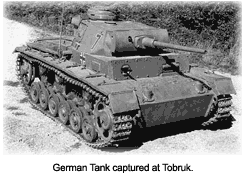
In 1940,the Italians invaded Egypt from Libya,however their biggest mistake was that they stopped at Sidi Barrini.The British commander,General Richard O'Connor seized the opportunity to launch a major offensive against the Italians.They were outnumbered by 3 to 1,however due to their training and the use of updated weapons and tatics,the British 8th Army were able to push the Italians out of Egypt,into Libya and stopped at Mersa Mertruh.The Italian dictator asked Hitler for help and he sent General Erwin Rommel along with the 15th and the 21st panzer division to Tripoli to help the Italians in North Africa.After landing in the capital and inspecting the troops,he ordered an immediate attack on the British lines.The British were thrown back with heavy losses,all the way to the Egyptian border.The only port city that did not fall to the famed "Desert Fox" and his Afrika Korps was the port city of Tobruk. Tobruk was garrisoned by British-Australian-New Zealanders-South Africans-Poles.They sent out recon parties to gather information / snatch a prisoner/destroy fuel& ammo depots.For this , the enemy called them the "Desert Rats", a name that stuck with them until the end 1943, when the axis control of north africa came to an end.
In the 1930s, Laszlo Almasy set out to find the lost oasis of Zarzura - the mythical place mentioned in Arabian treasure books. He explored 2 million square kilometers of the Sahara, drawing maps and seeing places "that no human eye had seen." In 1942, Almasy guided Nazi agents into British-occupied Egypt in a mission known as "Operation Salam." The adventurer worked for the "Brandenburg Division," a legendary German unit that carried out raids behind enemy lines. Almasy's diaries have disappeared, but reports he wrote for the Nazis were captured and are now locked away in the Imperial War Museum in London.
Feb. 14, 1943: American 34th Infantry Division faced off against a battle-hardened German Army in North Africa. In command of Hitler's Panzers was General Erwin Rommel. In 2002 Joe Boitnott and Duane Stone recalled their face-off with the Wehrmacht at the Faid Pass. "The commanding officer... run out of ammunition and run out of manpower," said Boitnott. On Feb. 25, the battle for the Kasserine Pass was over. "They had more than 6,000 casualties. They'd had units completely destroyed. In terms of yardage lost, it was the greatest defeat for the American Army in WW2," said Atkinson. Dwight D. Eisenhower reacted to the loss, calling in General George Patton.
Britain won critical victories over the Italians in Africa for 3 years before the battle of El Alamein in Oct. 1942. For example, in Feb. 1941 the British Western Desert Force under General Sir Archibald Wavell won the battle of Beda Fomm against Marshal Graziani's much bigger 10th Italian Army, and took 113,000 POWs. So huge were the British victories in Africa, that Adolf Hitler had to save his fellow dictator Benito Mussolini. Soon after the arrival of General Erwin Rommel in Tripoli in March 1941, Afrika Korps began to achieve such victories (like seizing the vital Libyan port of Tobruk on 21 June 1942) that disaster threatened British-run
The North African Campaign, or Desert War, took place in the North African desert during World War II between 1940 and 1943. North Africa is a region generally considered to include Algeria, Egypt, Libya, Mauritania, Morocco, Sudan, Tunisia, and the Western Sahara.
The North African Campaign was fought mainly for two reasons. The first was the Suez Canal, which was crucial to controlling the Middle East. The second was Middle Eastern oil resources. Control of Egypt was especially important because it sat at the center of a vital geographic-strategic network that included the Eastern Mediterranean, Abyssina (invaded by the Italians in 1936 and liberated by Britain in 1941), the Middle East as well as the Suez Canal.
When Italian dictator Benito Mussolini declared war on the Allies on June 10, 1940, he already had more than a million men in the Italian army based in Libya. In neighboring Egypt, the British Army had only 36,000 men guarding the Suez Canal and the Arabian oil fields. Italian forces became a potential threat to Allied supply routes in the Red Sea and the Suez Canal.
The early part of the North African Campaign was plagued by a lack of supplies on both sides. Sweeping battles took place that culminated with one side or the other's supply lines growing too long while the other's grew shorter. Major engagements of the campaign include the Battle of Gazala, First Battle of El Alamein, and the Second Battle of El Alamein. Most of the battles took place far to the east of the Italian bases and supply depots in Libya. By 1942, the Royal Navy had beaten the Italian fleet out of the Mediterranean, and allowed their own transports free movement. American forces landed in western North Africa in 1942.
The Siege of Tobruk took place from April to August 1941. The Allied garrison, largely Australian, backed by British artillery and tanks, captured the fortress in the first Allied drive through Libya, and held it against great odds.


Comments